
Great Decisions
Programs are usually the second Tuesday of the month from 7 to 8:30 pm October through May.
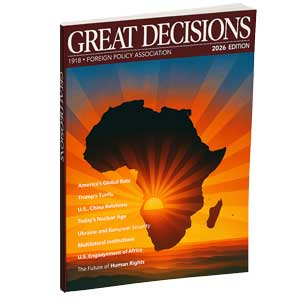
The purpose of Great Decisions is to educate citizens about issues of importance to American foreign policy and to provide them with the information to form opinions about the topics covered.
Pilgrim House has held a Great Decisions Program since 2007. We have found Great Decisions to be a stimulating and provocative learning exercise, and we encourage others to join us.
Great Decisions is a dynamic citizen education and discussion program, sponsored nationally by the Foreign Policy Association and coordinated locally by Global Minnesota. Speakers are informed and interesting observers of Foreign Policy affairs. We usually meet the first Thursday of the month, 7:00 at PH or via Zoom, and invite all to attend.
Each year eight issues significant to the United States’ role in the global community are chosen for discussion.
All are welcome to attend.
Next Program
The programs are currently via Zoom only. Information will be sent to current participants. If you would like to attend and don’t receive a Zoom link, email pilgrimhouse@pilgrimhouseuua.org.
October 13 – U.S. Engagement of Africa
Africa’s geopolitical importance is growing rapidly. What can the United States learn from China’s expanding presence on the continent? How might the U.S. strengthen its relationships with African nations, particularly an important country such as Nigeria? And what tools of statecraft can the United States bring to its engagement with Africa?
Our speaker is Henry Berman, who has spoken with us before about Israeli politics and regional relationships. Henry has personal ties to the Middle East and has spent considerable time there over the past decade. He has a strong interest in the changing dynamics of this turbulent region, as well as the emerging geopolitical importance of Africa and Southeast Asia.
Henry is a member of the Council on Foreign Relations and is active in a local Great Decisions group. He has given popular presentations throughout Minnesota on topics including Saudi Arabia, the future of the Kurds, Egypt and the Arab Spring, the Syrian refugee crisis, and the U.S.-Israel relationship. He holds a BA from Hamilton College and an MBA from the Tuck School of Business at Dartmouth College.
Great Decisions 2026 Topics
- America’s Global Role: Foreign Policy’s Next Chapter (often described as “Trump 2.0” foreign policy)
- Tariffs & the Future of the Global Economy
- Strategic Options for U.S.-China Relations
- Ruptured Alliances & the Risk of Nuclear Proliferation
- Ukraine & the Future of European Security
- Multilateral Institutions in a Changing World Order
- U.S. Engagement of Africa
Past Programs
2026
May 12 – Ukraine and the Future of European Security
With reduced U.S. support for NATO and Ukraine, Europe faces strategic uncertainty. The Trump administration has signaled an intention to reduce its security role in Europe. What are America’s stakes in NATO and Europe’s strategic dilemmas, and how might Europe respond?
Norma Noonan is Professor Emerita of Political Science and Leadership Studies at Augsburg College. The former director of the Master of Arts in Leadership Program at Augsburg, Noonan still teaches in the graduate leadership studies program. She is an expert in comparative and international politics and leadership studies, with special interests in Russia, women in society, and leadership theories. Norma Noonan earned a Ph.D. and M.A. in Political Science from Indiana University, a Certificate in Russian and Eastern European Studies from Indiana University, and a BA from the University of Pennsylvania. She is an avid traveler, most recently traveling to Russia and Central Europe.
April 14 – Multilateral Institutions in a Changing World Order
Can multilateralism survive amid shifting global power and rising nationalism? This program explores the future of global cooperation across trade, public health, and international finance.
Our speaker is Tanisha Fazal, the Arleen C. Carlson Professor of Political Science at the University of Minnesota. Her scholarship focuses on sovereignty, international law, armed conflict, and the global politics of climate change. She is the author of two award-winning books and a frequent media commentator on international security issues.
Professor Fazal has held fellowships at Harvard, Stanford, and the Carnegie Council on Ethics in International Affairs. From 2021 to 2023, she served as an Andrew Carnegie Fellow.
March 10 – U.S.–China Relations
Relations between the United States and China remain tense. Tariffs, rapid Chinese military modernization, and mounting pressure on Taiwan continue to shape the strategic landscape. Does President Donald Trump have a coherent China policy? Will tariffs on rare earth minerals prove effective? And what are America’s realistic strategic options going forward?
Our speaker is Nicholas Hayen.
Nicholas holds a Master’s degree in History and International Relations from the University of Utah. He has worked with nonprofit think tanks including the National Council on U.S.-Arab Relations and the Middle East Policy Council.
He currently serves as Marketing & Communications Manager for Global Minnesota.
Nicholas is also the creator of the blog and podcast series The Orientalist Express, which aims to make international relations accessible and to explain the benefits of American foreign policy to a broad audience. His publications include his Master’s thesis, “Brothers in Arms: American and Saudi Arabian Relations during the Soviet-Afghan War,” and “Combating Insurgency in British Palestine.”
He serves on the Minnesota Advisory Committee for the U.S. Global Leadership Coalition and lives in Brooklyn Park with his wife, Hannah, and their daughters, Mira and Florence.
February 10 – America and the World: Trump 2.0 Foreign Policy
Donald Trump’s return to the presidency marks a sharp break from nearly 80 years of U.S. foreign policy leadership. His renewed embrace of an “America First” approach raises questions about the future of alliances, global stability, and American influence. This topic explores the risks of isolationism and the potential consequences of diminished U.S. engagement in a rapidly changing world.
Our speaker is Kannan Solayappan. Kannan spoke with us last year and it will be especially interesting to hear his current thoughts on India-US relations.
Kannan Solayappan grew up in Chennai in Southern India and earned his undergraduate degree in chemical engineering at a university in Bangalore. In the late 1980s, he saw the promise of computers and went to Australia to study computer science, graduating with a master’s in 1992. He then came to work in the U.S. Starting as a software developer in the San Francisco Bay area, he moved to Minnesota in 1998 and has been a software consultant here for over 20 years. In these years he has worked in most of the major companies in Minnesota, including IBM, Mayo Clinic, American Express, Cargill, 3M, United Health Care, Medtronic, U.S. Bank and now Wells Fargo.
Kannan was first drawn to world affairs in 1979 when he encountered Henry Kissinger’s book White House Years by way of excerpts in Time Magazine. He was especially fascinated by Kissinger’s placement of political events in the grand sweep of history. Kannan’s interests expanded over the years to include intellectual history, philosophy and area studies, especially Europe, India and the Middle East. His perspective was also shaped by a wide array of life experiences, including as an international student, when he shared apartments with immigrants from Muslim countries and worked as a kitchenhand, waiter, laborer and market research interviewer to support himself. He has also spent time in Nigeria and Singapore. All of these experiences inform the pan-civilizational approach Kannan brings to politics and history in his book, Modernity, Civilizations and the Truth, and he looks forward to sharing his interests and views as a Great Decisions speaker.
2025
December 4 – The Future of NATO and European Security
Join us for a timely discussion on the challenges and choices facing NATO and Europe’s security landscape. This month’s topic explores key questions shaping transatlantic relations:
- Can Europe be made secure without U.S. involvement?
- Can the U.S. remain secure and prosperous if Europe’s security collapses?
- How would China’s military and economic support for Russia shift the balance of power if the U.S. reduces its role in Europe?
- What is the value of European strategic autonomy—does it strengthen or weaken the transatlantic security relationship?
We are delighted to welcome Norma Noonan, Professor Emerita of Political Science and Leadership Studies at Augsburg College, who haspreviously given us engaging conversations on NATO and Russia.
She is the former director of Augsburg’s Master of Arts in Leadership Program and continues to teach in the graduate leadership studies program. An expert in comparative and international politics and leadership, Professor Noonan’s research focuses on Russia, women in society, and leadership theory. She is a frequent lecturer and commentator in the Twin Cities and has authored over fifty articles and contributions to anthologies and readers.
Her works include The Encyclopedia of Russian Women’s Movements (Editor, 2001) and Russian Women in Politics and Society (Co-editor, 1996). Professor Noonan earned her Ph.D. and M.A. in Political Science and a Certificate in Russian and Eastern European Studies from Indiana University, and a B.A. from the University of Pennsylvania. An avid traveler, she has recently visited Russia and Central Europe.
November 5, 7:00pm – Artificial intelligence (AI) is often described as a disruptive force across all segments of society. But what are its implications for U.S. foreign affairs?
Rescheduled from October.
Our speaker will be Ren Bin Lee Dixon, an Artificial Intelligence policy researcher with a Master’s in Public Policy, specializing in AI governance, from the Humphrey School of Public Affairs at the University of Minnesota. As a Research Fellow at the Center for AI and Digital Policy (CAIDP), she provides policy recommendations to governments and multilateral organizations, including the U.K. Information Commissioner’s Office and UNESCO, helping shape frameworks for responsible AI governance.
Ren Bin also collaborates with the Center for Security and Emerging Technology (CSET) on policy briefs addressing AI harm. She has been invited to deliver guest lectures at the Humphrey School of Public Affairs, where she speaks on pressing issues in AI governance.
Prior to her policy career, Ren Bin accumulated more than 15 years of international experience in the fashion industry, working in Malaysia, China, and Denmark. Her global background provides her with a unique perspective on the complexities, risks, and opportunities presented by AI.
May 1, 7:00pm – U.S. Leadership in a Changing Global Economy
Under President Biden, the U.S. has introduced new approaches to trade, technology, industrial policy, and strategic competition with China, signaling a shift from the cooperative, open-trade agenda that defined much of the postwar era. What does this mean for America’s future as a global economic leader? How will a “foreign policy for the middle class” and intensified rivalry with China reshape the world order? Can the institutions and rules of the postwar system adapt to a world of economic nationalism and great power competition?
Our speaker, Dr. Richard Leitch, brings deep insight to these questions. He earned his B.A. in East Asian Studies from Colby College in 1985, followed by an M.A. in Asian Studies and a Ph.D. in Political Science from the University of Illinois at Urbana-Champaign. His career includes time on Wall Street and numerous teaching awards, including the Swenson-Bunn Award for Teaching Excellence and the Edgar M. Carlson Award for Distinguished Teaching at Gustavus Adolphus College, where he has taught since 1996. He was also featured in The Princeton Review’s The Best 300 Professors in 2012.Dr. Leitch’s research focuses on Japanese politics and foreign policy. We’ve always enjoyed his engaging, insightful presentations.
April 3, 7:00pm – American Foreign Policy in the Middle East: Taking Stock and Looking Ahead
The war in Gaza has brought the region to a crossroads. What are the possible outcomes of the war, and how might the United States use its influence to shape a long-term settlement that leaves both Israel and the Palestinians in a better position? How might Arab states in the wider region be brought into a settlement? What are America’s interests in the Middle East and how can it advance them?
Our speaker is Henry Berman, a retired businessman with personal ties to the Middle East Region who has spent much time there in the last decade. He has a strong interest in the ever-changing dynamics in this turbulent part of the world, including the emerging continent of Africa and Southeast Asia. Henry is a member of the Council of Foreign Relations and is active in a local Great Decisions Group. He has given popular presentations throughout Minnesota on such varied topics as Saudi Arabia, Future of the Kurds, Egypt and the Arab Spring, Syrian Refugee Crisis and the U.S.- Israel relationship. Henry has a BA from Hamilton College and an MBA from the Tuck School of Business at Dartmouth College.
March 5, 7:00pm – U.S.-China Relations
Washington’s relations with Beijing have reached an ominous low ebb. Both American political parties have identified China as the country’s preeminent geopolitical challenger and, in the eyes of many, a systemic threat. What is driving this deterioration of Sino-American relations, and what are America’s strategic options in the face of Chinese power and ambition?
Our speaker will be Edmund Downie, a PhD candidate in the Science, Technology, and Environmental Policy program at the Princeton School of Public and International Affairs. He studies how to overcome political and financial obstacles to the energy transition in the developing world, mixing case studies, (India, China, Vietnam) and energy-systems modeling. He is a co-author of the Guide to Chinese Climate Policy 2022 (Oxford Institute for Energy Studies) and has written in the Washington Post, Foreign Policy, Fortune, and Barron’s. He served as a Fulbright Scholar at Yunnan University in China (2017-18) and a Yale University Gordon Grand Fellow at the Center for Policy Research (Delhi) and the Center for Studies in International Relations and Development (Kolkata) (2014-15). He received an MPhil in International Relations at Nuffield College, Oxford as a Marshall Scholar (2017) and participates in a variety of Track II dialogues and subnational exchanges around US-China climate cooperation.
February 6, 7:00pm – India: Between China, the West, and the Global South
India today is an emerging power occupying a pivotal position in the world. As it marks its 75th anniversary in January 2025, the world’s most populous nation and largest democracy continues to defy simple categorization.
Our speaker is Kannan Solayappan, who grew up in Chennai in Southern India and earned his undergraduate degree in chemical engineering at a university in Bangalore. In the late 1980s, he saw the promise of computers and went to Australia to study computer science, graduating with a master’s in 1992. He moved to Minnesota in 1998 and has been a software consultant here for over 20 years now. In these years he has worked in most of the major companies in Minnesota, including IBM, Mayo Clinic, American Express, Cargill, 3M, United Health Care, Medtronic, U.S. Bank and now Wells Fargo. He lives in Eagan with his wife, Vallikannu, who works as a banker in Wells Fargo.
2024
December 5 – High Seas Treaty
Areas of the seas beyond national jurisdiction comprise the high seas, which are facing a degradation of ecosystems due to climate change and the increase in human activities, such as shipping, overfishing, pollution, and deep-sea mining. The recently negotiated High Seas Treaty, also known as the Biodiversity Beyond National Jurisdiction treaty, will attempt to address these issues. How difficult will it be to convince nations to participate?
Our speaker is Christi Siver, Professor of Political Science at the College of Saint Benedict and Saint John’s University. She did her undergraduate work at Lewis and Clark College in Portland, OR, her Masters in International Relations and International Economics at Johns Hopkins School of Advanced International Studies, and her Ph.D. in political science at the University of Washington. She teaches courses on international relations and international security. Her current research interests include international humanitarian law, military technology, and comparative law.
Christi gave us an interesting program on Climate Intervention in May of this year.
November 13 (Note Change!) – Understanding Indonesia
Despite its large size as the fourth most populous country in the world Indonesia remains virtually invisible to most Americans. But as one of the world’s largest democracies, the world’s largest Muslim-majority country, and as an economic driver of the ASEAN regional trade bloc, why does it fly below the radar? What are current issues in U.S.-Indonesian relations, and what role can the country play in Asia? Moreover, Indonesia is a recognized global leader in global health policy and reproductive health. world.
Our speaker will be Dr. Richard Leitch, who earned his Ph.D. in Political Science from Illinois in 1995, where he was the recipient of the Harriet and Charles Luckman Award for Distinguished Undergraduate Teaching. He has been a member of the Political Science Department at Gustavus since 1996, where he teaches courses in International Relations, Comparative Politics, Asian Politics, Environmental Politics, and the Politics of Poverty. His research interests include Japanese domestic politics and foreign policy, and he is the co-author of Japan’s Role in the Post-Cold War World.
October 3 – NATO’s Future:
Since the Russian invasion of Ukraine in February 2022, the North Atlantic Treaty Organization (NATO) has come under increased scrutiny, not because NATO troops are involved in the conflict, but because of its role in relations between Russia and its neighbors. Will expanding membership in NATO protect countries, or will it further provoke Russia?
Our speaker is Norma Noonan who spoke with us about Russia in 2022:
Norma Noonan is Professor Emerita of Political Science and Leadership Studies at Augsburg College. The former director of the Master of Arts in Leadership Program at Augsburg, Noonan still teaches in the graduate leadership studies program. She is an expert in comparative and international politics and leadership studies, with special interests in Russia, women in society, and leadership theories. Ms. Noonan is a frequent lecturer and commentator in the Twin Cities, and has authored over fifty articles and contributed to various anthologies and readers. She is Editor and contributor to the Encyclopedia of Russian Women’s Movements (2001), and the Co-editor and contributor to Russian Women in Politics and Society (1996). She is also a contributor to a forthcoming book on the emerging powers, which will come out in early 2013. Norma Noonan earned a Ph.D. and M.A. in Political Science from Indiana University, a Certificate in Russian and Eastern European Studies from Indiana University, and a BA from the University of Pennsylvania. She is an avid traveler, most recently traveling to Russia and Central Europe.
May 2, 7:00pm – Science Across Borders
Climate change poses an urgent challenge and despite current efforts, the risk of “overshooting” the 1.5 degree Paris Agreement goal is likely. In this environment, should all options, including risky technological “fixes,” be considered? Solar radiation modification, which promises to reduce the surface temperature of the earth, also carries substantial risks, including regional droughts, flooding, and extreme weather events. Unfortunately, the effects (both positive and negative) of solar radiation modification, which is being researched by international organizations, global networks of scientists, individual countries, and private sector groups, cannot be confined to a single country or region. Who should decide on how to address the urgent threats from climate change?
Our speaker is Christi Siver. She was with us last year on the topic of war crimes.
Christi Siver is a Professor of Political Science at the College of Saint Benedict and Saint John’s University. She did her undergraduate work at Lewis and Clark College in Portland, OR, her Masters in International Relations and International Economics at Johns Hopkins School of Advanced International Studies, and her Ph.D. in political science at the University of Washington. She teaches courses on international relations and international security. Her current research interests include international humanitarian law, military technology, and comparative law.